Thursday, April 25, 2013

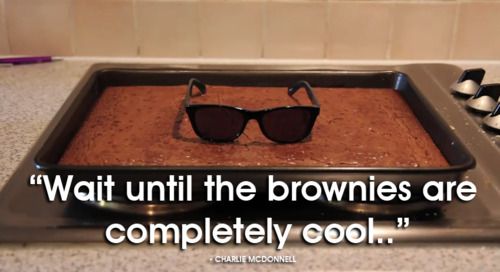
Chewy Brownie


Has anyone noticed that every single one of my recipe posts so far has been brown? Completely chocolatey... nothing else! For someone who claims open-minded variation, my single-minded focus when it comes to chocolate is quite peculiar. But I can't help but post one last chocolate recipe before broadening my food-blogging horizon to include less food-racist things.
The reason i'm delaying my resolution is because of the ultimate chocolate baked dessert. The brownie.

There are so many (SO MANY!) creative ways to shake up your brownie timeline, but one has to work up to those riskier, more complicated recipes. One must start with the classic brownie. And the classic brownie is in no way inferior to its brothers. No, it has the purest brownie flavor of all.

There is another aspect to brownies I should discuss. There are 3 kinds of brownies:

The Goey Brownie: The coplete opposite of dry, this one's my favorite.
The Chewy Brownie: Dense and rich, this brownie is a close second for me.
The Cakey Brownie: Light and fluffy, I find this brownie too dry and don't enjoy eating it. Go somewhere else for your cakey brownie recipes.

Decide what you like before making brownies you won't even enjoy eating. Which would be a massive loss and cause for grief.


I got this recipe off the Hershey's website here, and it's pretty good.

Ingredients

  • 1/2 cup (1 stick) butter or margarine, melted
  • 1 cup sugar
  • 1 teaspoon vanilla extract
  • 2 eggs
  • 1/2 cup all-purpose flour
  • 1/3 unsweetened cocoa powder
  • 1/4 teaspoon baking powder
  • 1/4 teaspoon salt
  • 1/2 cup chopped nuts or chocolate chips (optional)
Directions

  1. Heat oven to 350 degrees F (around 177 degrees C)
  2. Grease 9-inch square baking pan.
  3. Stir together butter, sugar, and vanilla in bowl.
  4. Add eggs and beat well with spoon.
  5. Stir together flour, cocoa, baking powder, and salt.
  6. Gradually add to egg mixture, beating until well blended.
  7. Stir in nuts or chocolate chips if desired.
  8. Spread batter evenly in prepared pan.
  9. Bake 20 to 25 minutes or until brownies begin to pull away from sides of pan.
  10. Cool completely in pan on wire rack.

Monday, March 25, 2013

Miniature Art Part I: Dalton M. Ghetti

Some great things in life are actually the miniature version of other successful normal-sized things.
  • Mini Chocolate bars
  • Action figures
  • Mini shampoo bottles
  • Pocket dictionaries
  • lap dogs
  • kittens
Likewise some of the most valued art around is the kind that pays attention to detail. You can't even begin to grasp the amount of concentration and persistence needed to complete such work. Honestly, it's quite fascinating to look at. And so our journey of mini-art begins! This will be the 1st post of a series, each post will feature an artist who has done amazing, original, and innovative miniature art.

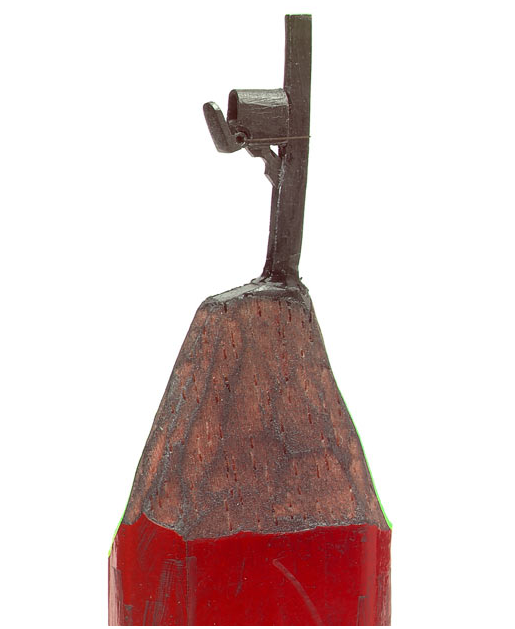
My first mini-art post will revolve around my main inspiration for writing this series of posts in the first place: the sculptures of artist Dalton M. Ghetti... on the tips of pencils!


A Brief Profile (taken directly from daltonmghetti.com)

Born and raised in Sao Paulo, Brazil.

Came to the U.S. in 1985 at the young age of 24.

Earned an Associate’s degree in Architecture from Norwalk Community Technical College, Connecticut, U.S.A. in 1994.

Works as a carpenter/house remodeler.

Self-taught artist: “Sharpens” pencils as a hobby/meditation.

Currently lives in Bridgeport, Connecticut, U.S.A.

For a full biography, follow this link here.

The longest Dalton has ever taken to finish a piece was two and a half years, and it was doing this one with the interlinking chains. The reason for that is that he works on the pencil-tip sculptures as more of a hobby and doesn't spend more than two hours a day working on them.

He says: “The interlinking chains took the most effort and I was really pleased with it because it’s so intricate people think it must be two pencils”


Dalton's tool's aren't anything extraordinary, he uses a razor blade, sculpting knife, and sewing needle. His mother was a seamstress, and she taught him how to use a sewing needle at an early age, which explains how it ended up among his three basic tools.

“I use the sewing needle to make holes or dig into the graphite. I scratch and create lines and turn the graphite around slowly in my hand”


 Ghetti's pieces aren't for sale, it goes against his reasons for making them to sell them. He does them for himself, not for anyone's approval. Working on them relaxes him, his art is "a form of meditation and enrichment of the soul" for him, like it is for many other artist professional or amateur alike. And he thinks of his art as a gift, nothing to profit from, he either keeps them or gives them to his friends as presents.


Another reason Dalton doesn't take on clients and paid commissions is because of the utter fragility of the work he does. He has broken many a pencil tip while working on it, and it's frustrating. Graphite is a brittle material to be sculpting into detailed forms and it could snap if one is too hasty.

"Now, if I am working on a paid commission with a deadline, that brings added pressure to this very tender process of sculpting a pencil. And that pressure may cause me to work too fast which can result in mistakes and breakage."

Actually Dalton keeps all his failed and broken creations, calling it "The Cemetery Collection" because as he put it:
"I worked on them for months so they might be dead now but at one point I gave them life."


Dalton sees a lot of waste in the world, and all his pencil art is a recycling process of discarded pencils thrown on the streets or in the trash. In fact his very first pencil sculpture was with a pencil he found lying on the sidewalk.

"I took it and gave it a new life."


Tuesday, March 19, 2013

Things You Wouldn't Want To Do If You Had Taste Buds On Your Hands

And another weird pastime of mine is revealed!
I make lists. 
Not to-do lists, heavens no. I make funny lists, like the one I'm about to share with you. A fair warning though, if you get easily disgusted DO NOT READ FURTHER. Seriously, I don't want to hurt any of your delicate sensibilities.

THINGS YOU WOULDN'T WANT TO DO IF YOU HAD TASTE BUDS ON YOUR HANDS
  • Go to the bathroom
  • Take out the trash
  • Do the dishes
  • Squeeze lemons
  • Pick your nose
  • Scratch your butt
  • Pet an animal
  • Get your hands licked by said animal
  • Clean the litter box
  • Be a hairdresser
  • Be a masseuse (except if you're into that sh*t)
  • Use a pay phone
  • Touch the table at McLarence's Pub after whatever Barney did to it
  • Play any sport where you touch a ball
  • Milk a cow
  • Stab someone (except if you're into tasting someone die... you sick f*ck)
  • Get sweaty palms
  • Be a plumber
Be hygienic people. If you don't want something in your mouth, why would you let it get and stay on your hands? It will end up there anyway if you don't wash them. 

AND FOR THE LOVE OF ALL THINGS HOLY OR UNHOLY ALIKE, DO NOT COOK WITH DIRTY HANDS!

Anyway, that was my hygiene campaign. Hope I got through to you!  

Friday, February 15, 2013

Nutella Mug Cake


Oh dear readers, what I’m about to share with you will truly change your lives forever. It will solve life’s most basic problem. The one I face with rather unnatural frequency.

A chocolate craving.


But when it hits you, it hits you hard. Like no-holds-barred take-no-prisoners must-find-chocolate NOW hard. There are times when the craving defeats you. When you’re just not in a state of mind to bake. And those are very tragic times indeed.

Now I know that what I’m about to say is practically blasphemy, but there is a point one reaches where eating spoonfuls of Nutella gets… old. And kind of boring. I know, I know, how dare I? Nutella is life, the universe, and everything.


But there are other ways to consume the ambrosia that is Nutella; more creative ways of including it in your desserts. Nutella cookies, Nutella muffins, Nutella pancakes…


And then there is the Nutella mug cake.


The nutella mug cake is a fine specimen. It's fast, easy, tasty... and it doesn't make a mess in the kitchen! Truly, you don'e even have to use the oven. You basically need the ingredients, a mug, a spoon, a fork, and a microwave. That's it. 


Nutella Mug Cake Recipe

  • 4 tbsp flour
  • 3 tbsp sugar
  • 1 tsp espresso powder
  • 1 egg
  • 3 tbsp cocoa
  • 3 tbsp nutella
  • 3 tbsp milk
  • 3 tbsp oil
  • Pinch of salt
  • OPTIONAL: A handful of Chocolate Chips


  1. In a mug (Preferably a big one. Depending on the size of your mug, the recipe might make 2) use a fork to whisk the egg a little.
  2. Add milk & oil and mix together. 
  3. Mix in the Nutella well.
  4. Add cocoa, sugar, espresso powder, and salt. Mix well.
  5. Fold in flour with fork. Mix well but be carful as not to overmix else you will get a rubbery, tough texture.
  6. Mix in chocolate chips if you're including them.
  7. Microwave for 2 1/2 to 3 minutes on high. You will have to figure out how long you want to microwave.
  8. Let cool a bit and dig in.

Monday, February 4, 2013

1984 by George Orwell


Dystopia (n.): a work of fiction describing an imaginary place where life is extremely bad because of deprivation or oppression or terror, typically a totalitarian one.

1984 is my first non-YA dystopia. Sure there are some good YA dystopias out there like The Hunger Games or Unwind. But that doesn’t change the fact that in YA you know where the story is going: our heros will rebel, our heros will either save everyone or at least themselves, our heros will defy or defeat the evil that oppresses them. There is invariably always an out, and you come to expect and await the rising of the people. YES OKAY, we’ve seen it all over and over. It’s like a broken cassette tape at this point.

1984 is a dystopia, but it is definitely not a YA dystopia. And thank god for that!

The Synopsis I found on Goodreads:

Written in 1948, 1984 was George Orwell's chilling prophecy about the future. And while the year 1984 has come and gone, Orwell's narrative is timelier than ever. 1984 presents a startling and haunting vision of the world, so powerful that it is completely convincing from start to finish. No one can deny the power of this novel, its hold on the imaginations of multiple generations of readers, or the resiliency of its admonitions. A legacy that seems only to grow with the passage of time.

Points to know:

  • Winston, our main character, lives in a future London ("future" considering the book was written in 1948) which is controlled by a group called The Party.
  • There is the Inner Party and the Outer Party; Inner being the powerful one that has the real control. Then there’s the Proles (Proletariat) at the bottom of the food chain.
  • Winston is part of the Outer Party;  he works a desk job at the Ministry of Truth.
  • The Party demands the complete submission of its people, body and mind; one is not allowed to have a rebellious thought. If he does, the Thought Police will find him, and destroy him.
  • Let’s just say Winston is being a very bad citizen, he thinks for himself and he hates the Party.


  • We follow Winston through his struggles.

I’m going to tell you a story I thought of as I was reading this book. 

Once upon a time there was a king and a queen ruling over a prosperous village. All the villagers loved and admired them for they ruled fairly and competently. But one day, a spiteful witch poisoned the village well with a potion that turns all who drink from it mad. The king and the queen were unaffected because they drank from a different well, one that was not poisoned. Great sorrow hit them as they found out that their villagers now lived in their own world, leaving them alone in the real world. Their rulings were no longer considered fair, and they were considered wise no more by their people. They became the ones who are insane in the eyes of everyone. So the king and queen decided to drink from the cursed well to join the people in their new reality. And so they went mad, and all was right again within the kingdom; and the king and queen regained the respect and devotion of their people.

Would you have made the same decision as the king and queen? Would you have gone with the flow? Or gone upstream, desperately clinging to your sanity?

Winston goes through a similar struggle. Should he cling to what he knows is reality? Should he search for the truth concerning the past? Or should he go with the flow, accepting all the lies, and not risk getting discovered?

You don’t know what to think in this book, and that’s because you can never really be sure of the extent of the Party’s power. Do they really see everything? Is the saying “Big Brother is watching you.” just for show? You may or may not find out.


1984  talks about  many interesting themes, like the way technology can be used for destructive purposes – which isn't really new today, but this book was written before computers where fully developed, so you can see the extent of Orwell’s foresight. He shows it through something called the Telescreen, which releases a stream of endless propaganda while simultaneously spying on anyone within its range. It provides audio and video feed to the Though Police, which is responsible for monitoring all Party members.

It shows the human mind as a fickle, controllable little piece of putty, manipulated and deceived into believing anything and everything fed to it by its controllers. The purpose of that deception is to perpetuate the existence of The Party forever. This concept pushes the people to defy logic, to apply something called doublethink. Doublethink is explained in the book as follows:


"Doublethink means the power of holding two contradictory beliefs in one's mind simultaneously, and accepting both of them"


Orwell explores the way war is used as a distracting for the people, as a way to explain why the standard of living is so low. War is a stepping stone to reach power. There is no reason to it beyond the conquest of power, beyond greed and human arrogance.


He also raises philosophical little points:

If reality is only seen through the mind, who’s to say what’s real and what’s not? If everyone sees the same thing, does it matter that it’s not actually there? What is the outside world really, if it is seen through a distorted view by everyone? Imagine everyone is wearing yellow-tinted glasses and is trained to NEVER take off those glasses. Then everyone sees the world in shades of yellow. The reality becomes that the world is indeed in different shades of yellow. If reality is what you see, and what you see can be affected by the mind, then does he who controls the mind, control reality?
And what if someone were to take off those glasses. Would anyone believe him? Would he even dare speak the truth?


Similarly, here's a quote from the book:

"He who controls the past controls the future. He who controls the present controls the past."

If someone controls what people believe is the past, he can make it out to be a horrendous travesty of what it actually was, and then claim improvement when the world is actually declining. So if you destroy all records of the past, substituting them with your own versions, and memory is no longer reliable, then does the past exist the way it happened, or the way you said it happened?


1984 serves a different purpose than what I’ve been reading. It aims to educate, it’s meant as an eye-opener. It warns of the dangers of giving others power and trusting them to do right by you; totalitarian systems are one's enemy, and one must avoid them at all costs.


Orwell meant the book as a warning against communism in a time when it was being seriously contemplated.  Also,  it warns you to think; to look beyond your short little noses, to see the world around you for what it really is through your own eyes.  The book says: Think for yourselves and don’t let anyone have power over you.

And who’s to say we are not today the sheep-like people described in Orwell’s book? Propaganda is such a basic part of our lives, that most don’t even notice it anymore. Who’s to say we are not manipulated into thinking what we think, and living the way we live? Who’s to say we aren’t too distracted by our miserable lives to realize something crucial?